



Decentralized exchanges remain to play an increasingly significant role in how people trade their cryptocurrency. Rather than using platforms to trade their cryptocurrency, people are now using smart contracts. PulseX is one such decentralized platform. This platform is a decentralized exchange tailored for PulseChain.
This article will tell you all about PulseX, its functionality, and its importance. It will provide an analysis of the PulseX Price, market, and past performance in its role as the Utility Token, PLSX. No hype. No promises. Just the facts.
What sets PulseX apart, then? Well, let us explain.
What is PulseX?
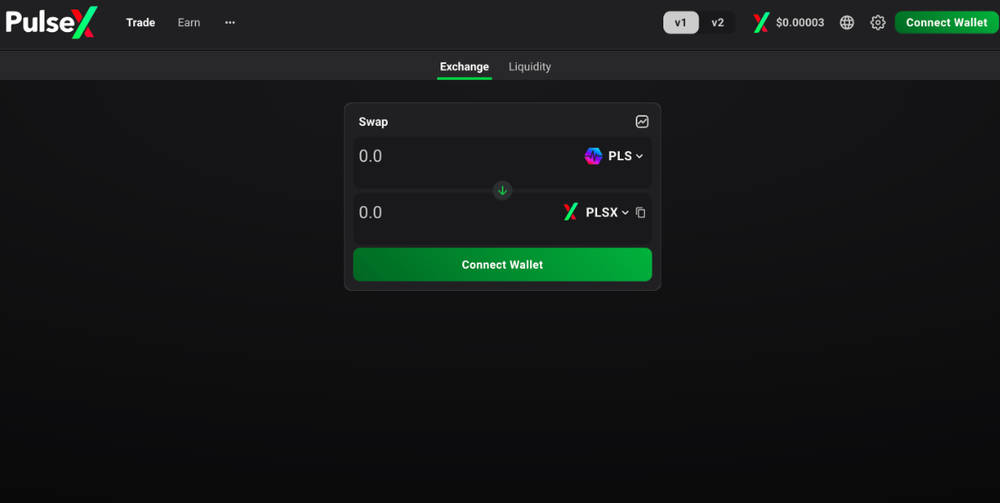
PulseX is a Decentralized exchange also known as a DEX. This is a product developed for PulseChain. PulseX enables users to exchange their tokens directly from their wallets without having to surrender control of their assets. No account registration is required.
Instead, PulseX relies on liquidity pools. This means that users trade their assets with pools of tokens that are contributed by other users. The benefit that the contributors get is the trading fees.
At the heart of this system is PLSX token. The token is used for incentives and rewards and other purposes within PulseX ecosystem. PulseX is not designed to replace all exchanges. The purpose is more specific. The platform is for users who require on-chain trading on PulseChain.
Sounds technical? Well, let's see how it actually works.
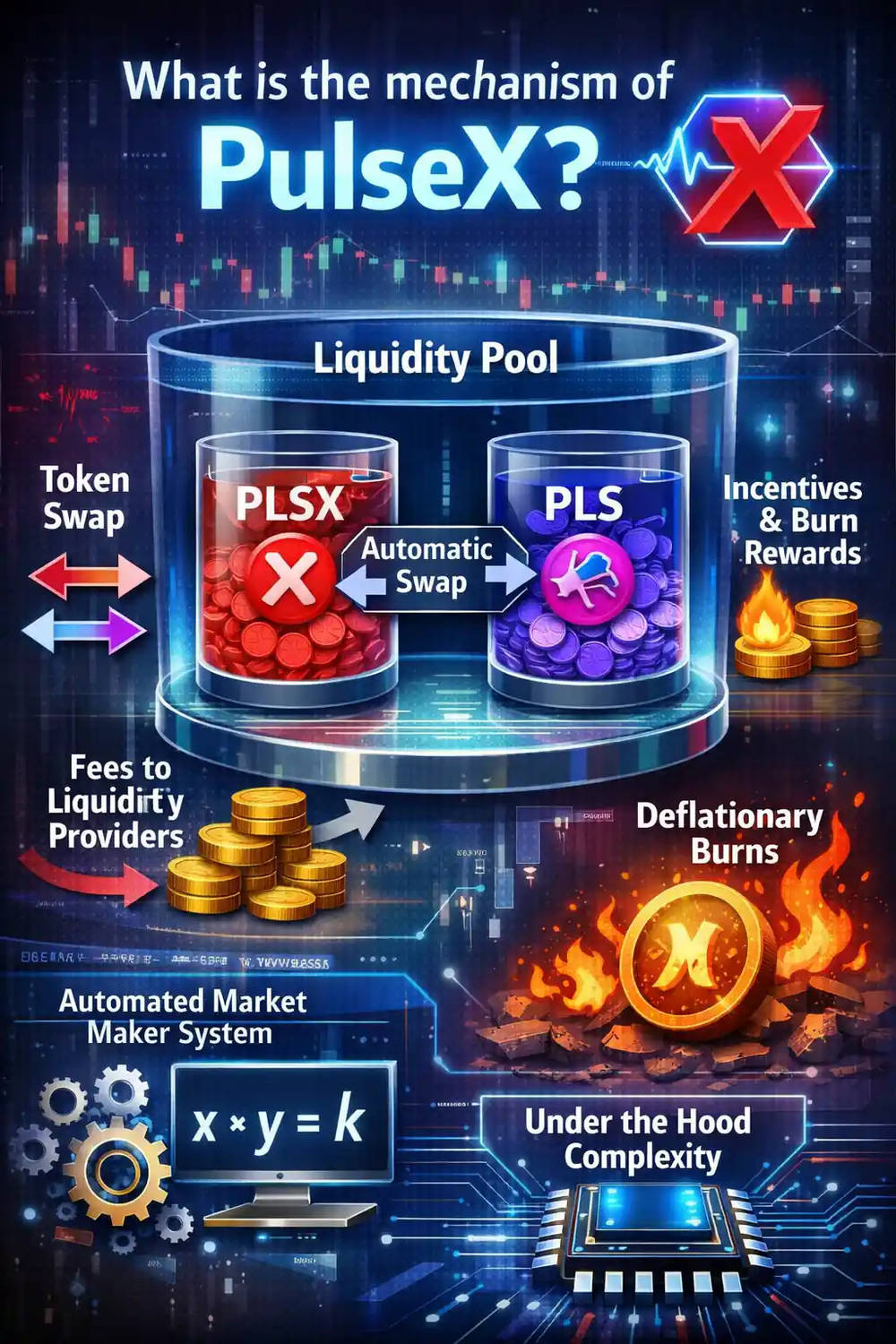
What is the mechanism of PulseX?
PulseX is based on an automated market maker mechanism. It is based on an equation, not on an order book. A person trading tokens causes an imbalance in the pool of tokens. It adjusts itself automatically.
The liquidity pool always has two tokens in it. Take, for instance, a PLSX pair, which always comprises PLSX and another asset of PulseChain. The trade is based on exchanging one of the assets for the other. There is a small charge incurred in the trade. The charge goes to those who provide liquidity.
PulseX also has features that promote liquidity in the long run. These may include incentives and burn rewards. These variables may be adjusted based on governance and changes in the protocols over time.
In other words, PulseX is a token swapping solution and the complexity is hidden under the hood.
What are some possible applications of PulseX?
The PulseX network has one main usage, and that's for token swapping in the PulseChain network. This is basically the main intention behind the creation of PulseX. However, there are some more functions.
First of all, it offers liquidity infrastructure. The projects on PulseChain can list tokens without permission. They require liquidity only.
Second, PulseX also supports yield strategies. Liquidity providers in the platform are able to earn fees from trading. In addition, some of them also get rewards from the protocol, depending on the pool.
Third, it serves as a pricing mechanism. The prices of tokens on PulseChain commonly refer to PulseX pools. This implies that it's a crucial data provider for the ecosystem.
Thus, PulseX is more than a swap utility. PulseX is a building block of the network.
What is the background of PulseX?
PulseX was launched along with the rest of the PulseChain ecosystem. The main aim of PulseX was to provide PulseChain with its very own decentralized exchange from launch.
Rather than building from the ground up, PulseX chose to use the successful model from other DeFi platforms. This is because the platform aimed to be efficient, charge low fees, and confirm transactions quickly.
The PLSX token has also been created as part of this launch. This token is involved in the liquidity reward and other mechanics of the protocol. The project has also received some upgrades and tweaks over time just like other DeFi projects.
It is still relatively brief, although it is much longer than that of more traditional decentralized exchange projects. It is not surprising that it follows traditional trends, given that it is part of
What is the market value for PulseX?
The current market value of PulseX today varies according to market conditions and market sentiment in PulseChain. In most cases, since PulseX primarily trades on its native market, it may have different market dynamics from other tokens traded on major exchanges.
At any point in time, the price of pulsex reflects trades in liquidity pools. The price information may slightly differ among trackers depending on pool depth and time.
Thus, while looking for the pulsex price today, it is important to make use of authentic market data sources and know how that price is derived from those sources.
PulseX Price Chart
The PulseX chart above illustrates the movement of the price of PLSX. Such charts may point to periods of high volatility, especially in the vicinity of an ecosystem or market change.
Short-term charts may be noisy. Larger time frames are more informative. They indicate whether a token has been moving in an upward, downward, or sideways fashion.
Charts do not forecast what is going to happen in the future. Charts merely explain what has already occurred.
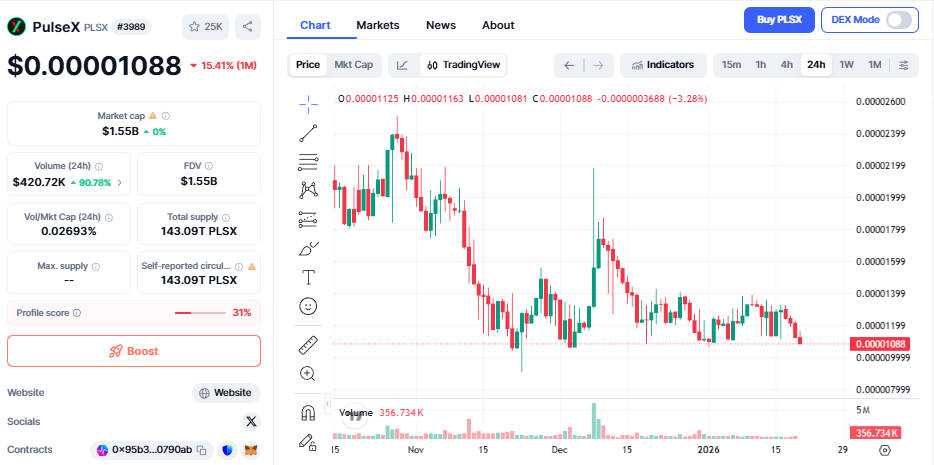
PulseX Historical Price
The historical price of PulseX represents its initial trading cycle and subsequent stable periods. Like other DeFi tokens, PulseX witnessed steep changes during its liquidity stage.
Passing time normalizes trading. This results in increased market liquidity. Market volatilities may reduce, but they may also occur when significant events take place.
Historical data will provide an answer to one question. How is the market performing with regards to PLSX so far?
What is the market cap of PulseX?
Market capitalization of PulseX is calculated by multiplying the current price of PLSX with the circulating supply. Market capitalization helps in understanding the size of the project in relation to other cryptocurrencies.
Market capitalization is not a measure of quality and use value. It is merely a reflection of its market value at a certain point in time. Nonetheless, it has become a reference point for many investors.
The market cap for PulseX can fluctuate rapidly depending on changes in either the supply or prices.
What is the fully diluted value of PulseX (PLSX)?
Fully diluted valuation takes into account the total number of tokens in circulation, not just those in circulation at any point in time. It is able to provide an answer to one question. What is PulseX worth if all PLSX tokens were in circulation?
This value is typically higher than market cap. This assists users in understanding future dilution.
FDV is not a forecast. It is a scenario using current price.
How much trading volume is there on PulseX (PLSX) on a daily basis?
The daily trading volume is the level of activity of the market on the exchange. This is an indicator of market liquidity. The more the market is traded, the more liquid it is. Less trading activity may result in high.
During times when there is intense interest in PulseChain and when there are updates on PulseChain protocols, volume is likely to rise. When there are quiet days, there are likely to be sharp falls in volume.
Such a metric can be used to gauge how easy it is to get in and out of a position.
What is the highest and lowest price of PulseX (PLSX)?
The highest price is associated with peak demand in times when the market is performing well. The lowest price is associated with early trading or when the market is declining.
These two points mark the entire price range of PLSX so far. These points demonstrate how volatile this token has been.
Extreme values in the past do not provide a guarantee for the future. They indicate only the possibilities that existed.
What is the price performance of PulseX relative to its peers?
In comparison to the rest of the DEX tokens, PulseX's performance has followed a familiar trend. Volatility in the initial phase, followed by phases of consolidation.
Performance is also linked to PulseChain activity. If the ecosystem expands, usage may rise. If activity dwindles, interest may wane.
In contrast to multi-chain DEX tokens, PLSX is more specific to the ecosystem. This allows for comparisons, though not entirely accurate.
PulseX Markets
The trading of PulseX happens mainly on decentralized markets on the PulseChain. The liquidity pools are the main markets for PLSX.
The reason is that it is not widely listed on centralized exchanges and is instead available based on wallet compatibility and network support, which is attractive to those who like trades to occur on chain.
This also means that users must have prior knowledge of how DEX trading works.
FAQ
When is PulseX launching?
PulseX is already launched and is functional in the PulseChain network environment. It is accessible via supportive wallets.
What factors affect PulseX's price?
The pulsex price is determined by supply and demand in the liquidity pools. Trading, depth of liquidity, and market mood influence it.
Is PulseX a centralized exchange?
No. PulseX is a decentralized exchange. Users retain control over their funds.
Is PulseX a registered or KYC-compliant platform?
There is no need for registration or identity verification. Access to your wallet will do.
Can prices in PulseX be different compared to other platforms?
Yes. Because prices are derived from liquidity pools, slight variations may show up across data sources.
Conclusion
It is a DeFi exchange that is designed for PulseChain. The exchange is modeled on DeFi tenets. The exchange is a liquidity pool exchange that is automated. The PLSX token has a functional use within this setup. The price of the PLSX token is dependent on activity, liquidity, and interest in the overall ecosystem. Analyzing the pulsex price today and the past data related to it assists a user in comprehending the position of the project. What's the key point then? PulseX is not about promise. It is about infrastructure.