


Bagwork Price Chart (BAGWORK)
Bagwork (BAGWORK) is a Solana token that is most often discussed as a micro-cap meme-style asset. In practice, the Bagwork coin market is shaped by liquidity in Solana pools and by how often traders rotate into and out of it during short attention cycles.
For day-to-day tracking, most readers follow the Bagwork crypto chart on large aggregators like CoinGecko and price pages from major platforms that index third-party markets.
BAGWORK Historical Price
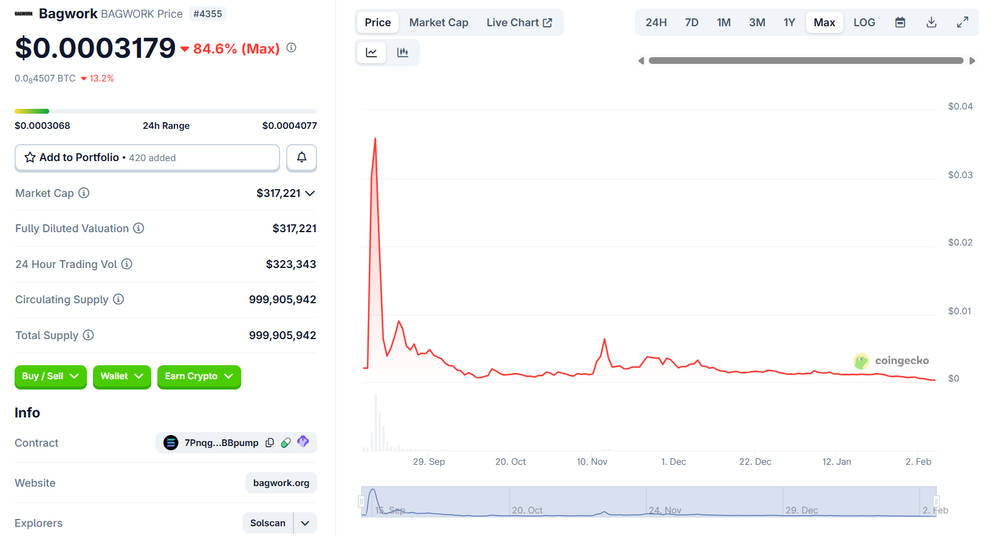
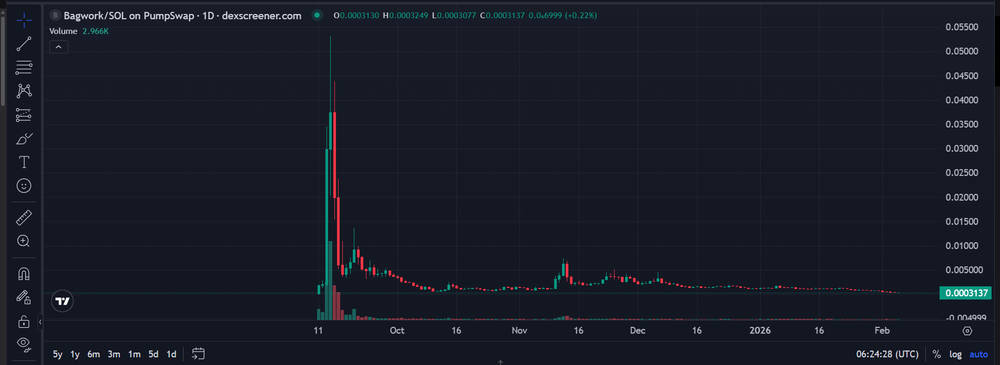
When you look at BAGWORK historical price, do not focus on one candle. Instead, look for phases: a launch phase, a period where liquidity stabilizes, and later waves where volume returns for short bursts.
Bagwork is shown on Solana explorers with its token address ending in "pump," which is consistent with a Pump.fun-style launch pattern.
That matters because Bagwork crypto tokens from fair-launch environments often show fast early price discovery, then quieter periods where price can move sharply on relatively modest order flow.
Where can you buy Bagwork?
The simplest answer is that Bagwork (BAGWORK) is commonly swapped on Solana DEX routes where its main liquidity pools exist. Pool trackers show an active BAGWORK/SOL pool on PumpSwap, and some dashboards also show alternative pools with smaller liquidity.
Some centralized platforms also publish BAGWORK price pages and market stats, but that does not always mean the asset is directly tradable there. If you see "not tradable" messaging, treat the page as an index, not as a venue.
Practical checklist before any swap:
- Verify the BAGWORK token address on Solana.
- Compare the quoted output across at least two routes.
- Start with a small test swap if it is your first time using that pool.
What is the daily trading volume of Bagwork (BAGWORK)?
Daily trading volume tells you whether the market is active or thin. On CoinGecko, BAGWORK often shows six-figure 24-hour volume snapshots, but the number can vary meaningfully day to day.
It is also normal to see different volume numbers across data providers because they may index different venues or pool sources. This is why Bagwork coin volume should be read as a range rather than a single "perfect" truth.
What is the highest and lowest price for Bagwork (BAGWORK)?
Most trackers publish all-time high and all-time low reference points. These are useful for context, but they can differ by source depending on how each platform treats early low-liquidity prints or data gaps.
If you use an "all-time high" number, treat it as a historical marker, not as a target. For a Bagwork crypto asset in micro-cap territory, the path between high and low can be dominated by liquidity depth rather than fundamentals.
What is the market cap of Bagwork (BAGWORK)?
Market cap is typically calculated as circulating supply multiplied by price. Several platforms show Bagwork (BAGWORK) with a supply figure around 1 billion tokens and a market cap that shifts with price.
Because BAGWORK can move quickly, market cap snapshots can look inconsistent across websites at the same time. That is not unusual for a Bagwork coin that trades mainly through on-chain pools and is indexed by multiple aggregators.
What is the fully diluted valuation of Bagwork (BAGWORK)?
Fully diluted valuation (FDV) estimates the token's value if the maximum supply is considered in circulation. On some platforms, BAGWORK is shown with total supply around 1 billion, while others may not show a max supply value clearly.
In practical terms, if circulating supply and total supply are close, FDV tends to sit near market cap. If supply data is unclear, treat FDV as approximate.
How does the price performance of Bagwork compare against its peers?
The cleanest peer group for Bagwork (BAGWORK) is not large-cap crypto. It is:
- Solana micro-cap tokens
- Meme-style tokens that trade mostly via DEX pools
- Assets with similar liquidity depth and similar holder concentration risk
Some price pages provide "BAGWORK vs markets" comparisons to show how Bagwork crypto has moved versus broader benchmarks, but these are still just performance snapshots.
A more reliable comparison method for a Bagwork coin is to compare:
- 24h volume
- pool liquidity
- slippage for a standard swap size
- how quickly volume fades after spikes
BAGWORK Exchange Inflows & Outflows
"Exchange inflows and outflows" means how many tokens move into known exchange wallets versus out of them over a period. For major coins, this is often tracked by analytics providers. For a Bagwork crypto token, the data can be limited because trading may be concentrated in on-chain pools rather than centralized exchange hot wallets.
If you want to approximate inflows and outflows for BAGWORK in 2026, the practical method is:
- Use a Solana explorer to identify large wallets and labeled entities (if labels exist).
- Watch transfers to wallets that appear to be service wallets (high throughput, many unique senders).
- Cross-check spikes in transfer activity with spikes in volume on pool dashboards.
On-chain pool dashboards can help you time these checks because they show transaction counts and pool liquidity changes alongside price.
BAGWORK Net Flow
Net flow is simply inflows minus outflows over the same period. For a micro-cap Bagwork coin, net flow can sometimes be more informative than price because it hints at whether tokens are being positioned for selling pressure (more inflows to venues) or being pulled into wallets (more outflows).
If you cannot reliably identify exchange wallets, you can still use "venue net flow" as a proxy by tracking:
- Liquidity added or removed from the main pool
- sudden increases in sell-side pressure and price impact
- whether large swaps happen right after large inbound transfers
This is not perfect, but it is often the most realistic approach for Bagwork crypto when centralized flow data is incomplete.
Market details
Market details are the "reality check" numbers that explain whether the chart is supported:
- Supply (often shown around 1B)
- volume (changes day to day)
- liquidity in the main pool
- number of swaps or transactions in the main pool
For example, a PumpSwap pool page can show liquidity and 24-hour volume for BAGWORK/SOL, which helps you understand whether a move is supported by actual trading activity.
If liquidity is relatively small, even moderate orders can move the Bagwork coin price noticeably.
Network & Addresses
Bagwork (BAGWORK) is on Solana. If you only remember one verification step, remember this: always verify by address, not by token name.
The BAGWORK address commonly shown across trackers and Solana pages is:
7Pnqg1S6MYrL6AP1ZXcToTHfdBbTB77ze6Y33qBBpump
This matters because fake or lookalike tokens can copy the name "Bagwork" and even use the same ticker on other chains.
Price history
If you are trying to understand the Bagwork crypto story through price history, focus on the relationship between price and activity:
- When price spikes, did volume rise with it?
- When price falls, did liquidity drain or did it stay stable?
- Are there repeated patterns of short rallies followed by long quiet periods?
Price history pages can be useful, but for a Bagwork coin, they become much more informative when paired with pool data (liquidity and transaction count) rather than price alone.
Conclusion: Key takeaways about Bagwork (BAGWORK)
Bagwork (BAGWORK) is a Solana-based token that trades primarily through on-chain liquidity, so the Bagwork coin price in 2026 is best interpreted with volume and pool liquidity in mind, not just the chart.
If you track Bagwork crypto seriously, keep it simple: verify the Solana address, watch the main pool's liquidity and transaction activity, and treat "exchange flows" as an optional layer that may be imperfect for micro-cap tokens.